
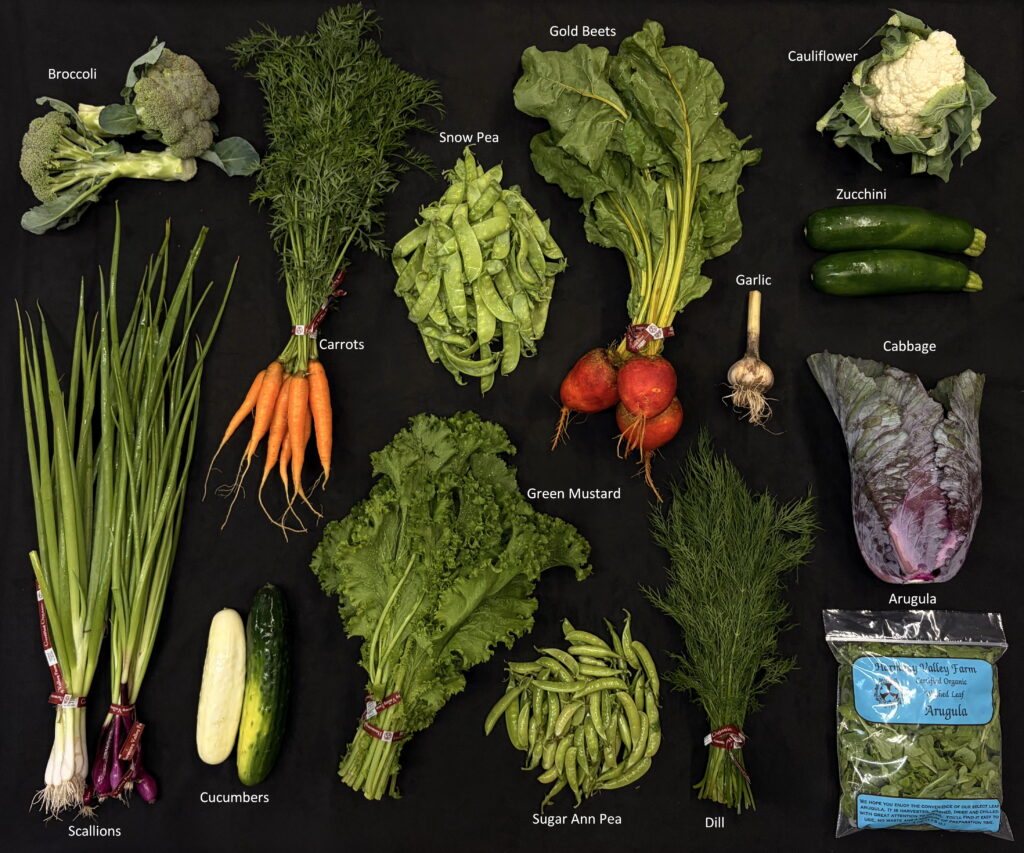
What’s In The Box with Recipe Suggestions
Arugula: Arugula is a spicy green that pairs well with other rich ingredients such as cheese, cured meats, nuts and fruit.
Arugula and Hard Cheese Salad with Toasted Garlic Vinaigrette
Green Top Gold Beets: If you are still learning to like beets, we encourage you to try gold beets as they have a milder beet flavor. While the beets themselves are packed with nutrients, so are their green tops!
Beet Greens Pesto with Pistachios
What To Do with Beet Greens—10 Ways to Love Them
Broccoli: Make the most of the broccoli in your box by making sure you use both the stems and the florets. The stems will require just a tad more cooking time than the florets. If you like to keep your broccoli bright green, cook it just until it’s tender. If you overcook it, the color will become drab green, and the texture will become smooshy. Also, cook it without a lid on the pan to allow the steam to escape. If you trap the steam, it will cause the broccoli to turn dull green.
Broccoli Slaw with Red Cabbage
Seriously Good Broccoli Slaw with Raisins and Sunflower Seeds
Red or Green Sweetheart Salad Cabbage: This week we’re delivering a unique variety of summer salad cabbage that produces a pointy head! You’ll find the leaves of this cabbage to be slightly sweet and tender, hence why it’s a good choice for eating raw in salads. You can also cook it if you prefer. Consider trying it roasted or grilled for something different!
Cauliflower Tacos with Shredded Red Cabbage and Avocado Crema
Green Top Orange Carrots: The green tops on carrots are a sign of a very fresh carrot! This week’s variety is an early season, tender, sweet carrot. Munch on these carrots raw or lightly cook them. And what about the tops? They’re edible too! Turn them into Carrot Top Pesto or Chimichurri! Don’t let them go to waste!
Cauliflower: Cauliflower may be enjoyed raw or cooked. If you’re cooking it, you may choose to roast it, grill it, include it in a stir-fry, bread it and deep-fry it, steam, boil or sauté it!
Cheesy Cauliflower Breadsticks
Roasted Cauliflower with Spicy Sake Dipping Sauce
Green and/or Silver Slicer Cucumbers: Cucumbers are one of those crops that can really take off and produce when we get a run of hot days, which we’ve had over the past week! Wondering what to do with all the cucumbers in this week’s box? Use them to stay hydrated in the heat of the summer!
Simply Dressed Cucumber & Mint Salad
Dill: This is a great summer herb to pair with fresh carrots or cucumbers. Use it in vinaigrettes and sauces, or incorporate it into salads, soup and main dishes.
Baked Carrot Fritters with Dilly Yogurt Sauce
Fresh Garlic: This garlic was harvested within the past week and is still in the process of drying down, thus it’s still classified as “Fresh” garlic. You’ll find the skin around the cloves is still moist and maybe a bit more challenging to remove. The clove inside is juicy, plump and has a bright flavor. You may use this garlic any time but store it at room temperature in the meantime so it may continue to dry down.
Green Mustard: Mustard greens are in the brassica family, along with kale, cabbage and collards. Mustard Greens are more delicate/tender and less bitter than kale and collards. They are peppery like arugula.
How to Cook Mustard Greens: 11 Mustard Greens Recipes
White and/or Purple Scallions: Scallions are the perfect onion to use raw in summer salads. Slice them thinly and use the green tops as well as the base of the onion!
Scallion Pancakes with Zucchini
Roasted Carrots with Scallion Vinaigrette
Sugar Ann Snap Peas: This is the ‘smaller’ bag, about .5-pound bag in the box. Just peel back the little stem on the top of the pod by pulling back on the end where the pea was connected to the plant. Enjoy them as a raw snack or in a fresh vegetable salad or lightly cook them until tender/crisp.
Crunchy Cucumber, Radish & Snap Pea Chopped Salad
Stir-Fried Shrimp & Sugar Snap Peas
Snow Peas: We have both the Sugar Ann and Snow peas in this week’s box, the Snow Peas are the larger bag, weighing in at .9 pounds. Snow peas have an edible pod, just remove the string that runs along the top of the pod. This is an excellent pea to use in stir-fry or very lightly cooked. They also make a great snack item to eat out of hand!
Green and/or Italian and/or Yellow Scallopini Squash: Use this week’s zucchini to make a simple Italian pasta dish or in a recipe for fudgy brownies!
Healthy Chocolate Zucchini Brownies
Garlic Shrimp and Zucchini Wrap
Vegetable Feature: Mustard Greens

Mustard greens are a leafy vegetable from the Brassica family, (commonly Brassica juncea) and are a hardy, fast-growing crop. The leaves can be flat or frilly, but are typically broad, with ruffled edges. Flavor-wise, they have a very distinctive, peppery taste, akin to arugula. Some people compare the flavor to horseradish—punchy and spicy. Thanks to their assertive flavor, mustard greens pair well with other strong flavors, such as garlic and onion.
Mustard greens are an extremely healthy vegetable, full of antioxidants, vitamins A, C, and K, and minerals such as calcium, magnesium, and potassium. These nutrients help support many key bodily functions, including immune and bone health. They’re also a good source of fiber, which is important for digestion.
When using mustard greens, you may choose to remove them from their stems. The stems are perfectly edible, although not as tender as the leaves, and many people keep them intact for added nutrients. They can be used as a substitution for other cooking greens, kale, collards, or Swiss chard. You will also want to wash them well in a sink of cold water until all of the dirt has been removed. Mustard greens can be eaten raw, and when doing so, there is a distinct mustard flavor.
Mustard greens are popular in Southern cuisine, as well as some Asian cuisines. Cooking mustard greens mellows their flavor and brings out their sweetness. The most popular Southern preparation is to braise the greens, often with ham, for a rich, savory dish. They can also be sautéed with aromatics, added to soups, and blitzed into pesto. For an Asian-inspired version, try adding sesame oil and soy sauce to the sautéed greens, along with ginger and garlic. You can simply sauté them with garlic and olive oil for a quick and easy side dish or try adding them to a casserole or frittata. Mustard greens pair well with ginger, sesame oil, soy sauce, white beans, garlic, onions, crushed red pepper, cream, shallots, bacon, eggs and white fish.
Mustard greens should be stored, unwashed, gently wrapped in a paper towel and placed loosely in a plastic bag. The bundle should be stored in the high-humidity bin of your refrigerator.
Farm Update

This week has brought high humidity and showers along with some thunderstorms. We shifted our working hours a bit to avoid the hottest part of the day in the fields. With the storms, we have been dodging the worst of them and receiving the rain, and as of this morning avoiding any of the recent hail and high wind damage that some of our neighboring towns have seen. As usual, we ride the differing weather waves and so far we are still doing great!
We started harvesting the fresh garlic, and the bulbs are looking as great as the tops did in the field! As we wait to harvest the rest of the field as the storage garlic we all know and love throughout the rest of the season, we have to wonder, will it all fit in our greenhouses to dry out? I guess only time will tell! The broccoli field is still producing well and we are starting to watch the potatoes, onions and green/yellow beans. They are not far from CSA boxes, another sure sign we are into the summer vegetable season!


