
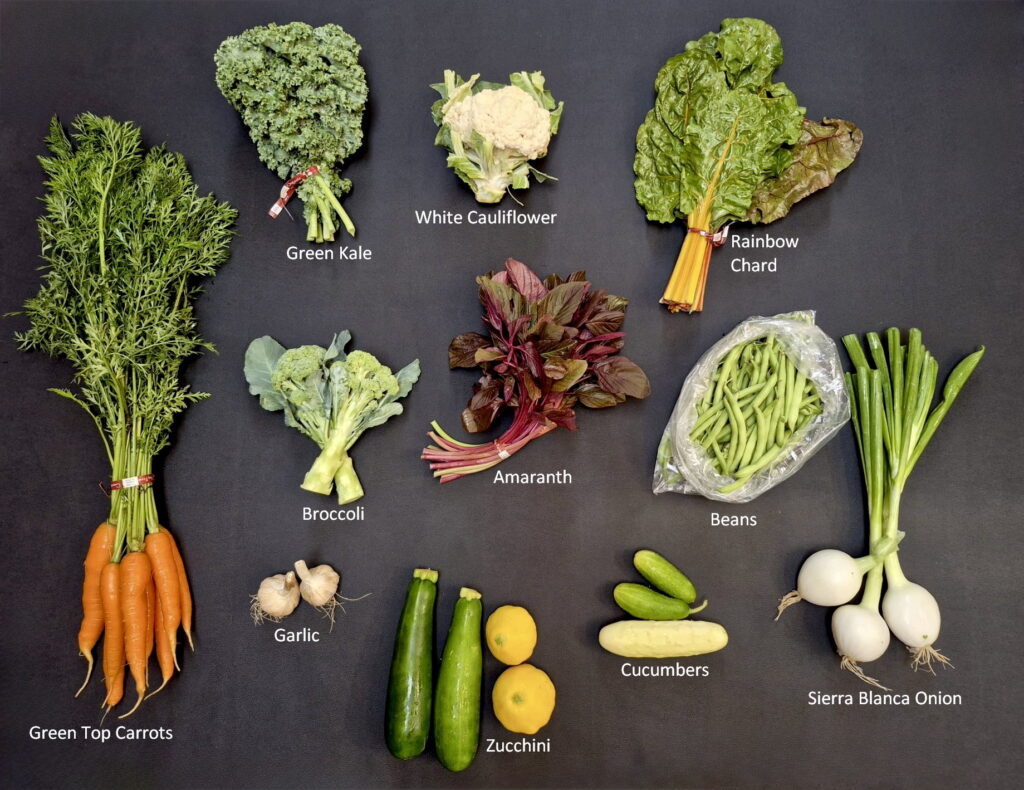
What’s In The Box with Recipe Suggestions
Amaranth: This is the gorgeous stunning “green” with dark, burgundy-colored leaves in this week’s box. It thrives in the heat of summer and pairs beautifully with summer vegetables. While it may be eaten raw, at this stage it is best if cooked. It tastes similar to spinach and may be used interchangeably with spinach in recipes.
Sonoran-Style Amaranth Greens (Quelites)
Green and/or Yellow Beans: Store in the refrigerator until you are ready to use them, then snap off the very tip of the bean to remove the stem end. Steam, grill, roast or sauté them!
Southern Green Beans and Potatoes
Broccoli: Peel away the outermost layer of skin on the stem to reveal the tender flesh inside. Shred it to make a broccoli slaw along with some shredded red cabbage!
Parmesan Crusted Broccoli Stem Fries
Green Top Orange Carrots: Enjoy the sweetness of these fresh carrots by adding them to raw salads or just eating them as a snack. Turn the carrot tops into chimichurri to serve alongside grilled fish, chicken, or beef. Alternatively, save the carrot tops and add them to your next batch of homemade broth!
Baked Red Lentil Falafel with Lemon-Herb Tahini Dipping Sauce
Cauliflower: Use it to make a tasty cream of cauliflower soup for a light dinner. Another simple way to enjoy cauliflower is to simply roast it in the oven or on the grill.
Cauliflower Banana Bundt Cake with Cinnamon Icing
Rainbow Chard: This beautiful green is packed with nutrients and flavor! It is most often cooked, but it may also be used raw. It is very versatile in its uses from something as simple as adding sautéed chard to your scrambled eggs in the morning or use it as an ingredient in lasagna!
Warm Lentils with Wilted Chard, Roasted Beets & Goat Cheese
19 Swiss Chard Recipes That Will Make You Wonder “Spinach Who?”
Green and/or Silver Slicer Cucumbers: Cucumbers are over 90% water, which makes them a great candidate for staying hydrated in the heat of the summer! You can create a delightful snack that is not only low in carbs but also rich in vitamins and minerals like Cucumbers with Tajín and fresh lime.
Noodle Salad with Chicken and Chili-Scallion Oil
Fresh Garlic: You’ll find the skin around the cloves is still moist and may be a bit challenging to remove. The clove inside is juicy, plump and has a bright flavor. You may use this garlic any time but store it at room temperature in the meantime so it may continue to dry down.
Garlicky Blistered Green Beans
Grilled Bone-In Pork Chops with Garlic Butter
Kale Green: We include kale throughout the summer and into the fall because it’s a nutritious green that may be enjoyed in a variety of ways During the summer months, consider turning it into baked kale chips to snack on or use it to make a “massaged” kale salad. Kale salads are great to make in advance and take on picnics or road trips.
Sierra Blanca Onions: This onion has very thin skin and is intended to be eaten fresh, not stored. Slice it thinly and eat it raw on salads and sandwiches or sauté it gently to bring out its natural sweetness. This is the perfect summer onion to serve with burgers, sandwiches, added to salads, or tossed on the grill.
Italian Sausage, Peppers, and Onions
Oklahoma-Style Onion Burgers Recipe
Green and/or Italian and/or Yellow Scallopini Squash: This is one of our staple vegetables for the summer season and there are thousands of ways to put it to use. Scallopini squash is shaped differently but may be used interchangeably in most recipes that call for zucchini…especially if you are dicing or shredding it.
Vegetable Feature: Amaranth

This week’s featured vegetable is not only gorgeous, but it’s also packed with nutrition! We’re talking about Amaranth Greens! While this is a “green” type vegetable, the leaves on this beauty are actually a dark burgundy red color.
Amaranth is thought to have originated in Central and/or South America but has made its way around the globe. It can be found in Europe, Asia, and the Americas, which means there are many options for finding ways to use this vegetable. Amaranth is used in Indian cuisine, paired with a variety of lentil and curry dishes. It’s also used in the Caribbean where it’s known as callaloo and is used in soups laced with coconut and chiles. You’ll also find amaranth in Chinese cuisine, either lightly stir-fried with garlic, etc. or incorporated into a simple soup such as the one featured in this week’s newsletter! As we mentioned, amaranth is thought to have originated in Central and/or South America, so it also pairs well with flavor combinations from the cuisine of these regions. One of the reasons we choose to include amaranth in our line-up of “CSA Vegetables” is because it thrives in the heat of the summer when other greens and lettuce really struggle. As such, it goes well with all those other summer vegetables including zucchini, eggplant, peppers, potatoes, tomatoes, corn, onions and garlic.
Amaranth could be called one of our own “superfoods.” The leaves are rich in calcium, phosphorus, protein, vitamin C, carotene, iron, B vitamins, and trace elements including zinc and manganese. Compared to spinach, amaranth leaves have three times more vitamin C, calcium and niacin! Of course, we know vegetables that have rich colors like the magenta leaves of amaranth are also packed with important phytonutrients and antioxidants.
The variety of amaranth we grow is referred to as “Polish Amaranth.” We purchased the seed from Wild Garden Seeds (WGS), which is kind of funny because our own Farmer Richard is the one who actually gave them the seed originally! For those of you who haven’t heard the story, it goes like this: One day Richard was driving to LaCrosse, WI and saw this beautiful red amaranth growing in a garden along the way. He stopped and asked the people who lived there about this plant. They said their Aunt May brought the seed with her from Poland and they were happy to share it with Richard. So, Richard collected some seeds and started growing them, mostly as a baby green to mix into his gourmet salad mix. It didn’t do so well as a salad mix ingredient, but in later years we found success growing it as a mid-summer bunching green used for cooking. Since we aren’t in the business of seed production, Richard passed the seed onto Frank Morton at WGS and he has been maintaining this variety of amaranth. Thanks Frank!
While amaranth may be eaten raw, at this stage where it is more mature, we recommend enjoying it as a cooking green for optimal flavor. The stems are often tender enough to be eaten as well. The stems will need just a little extra cooking time, so I like to separate the stems and leaves. Cut off about one inch of the lower portion of the stem and then finely chop them. When cooking, add the stems to the pan a few minutes ahead of the leaves. Amaranth can be simply boiled, steamed or sautéed with garlic and onions for a super-simple preparation. You can also wilt it into soups, grain dishes, curries, and bean dishes. Many of the nutrients in amaranth, including the phytochemical that gives it its pink color, are water soluble. Thus, you’ll notice when you cook amaranth the leaves will often turn green and the cooking liquid or other ingredients you’re cooking with the amaranth will turn pink! Always try to use any cooking liquid (e.g. if you choose to simmer or boil amaranth) so you retain the nutrients. Amaranth is similar in flavor to spinach, except it’s even better!
Store amaranth greens in the refrigerator loosely wrapped in a plastic bag or a storage container with a lid. If you want to enjoy their beauty before you eat them, you can also put them in a vase and leave them at room temperature where you can see them! Be sure to change the water daily.
Farm Update – Cyclosporiasis Statement
First, what is it? Description directly from the FDA website: “Cyclosporiasis is an intestinal infection caused by the parasite Cyclospora cayetanensis. Cyclosporiasis outbreaks have been associated with the consumption of fresh fruits and vegetables around the world, including in the U.S. Cyclosporiasis occurs only in humans, the only known host for C. cayetanensis. The most common symptom is diarrhea. Infected people shed the parasite in their feces — good hygiene and other sanitary protections such as those described in the Produce Safety Rule (e.g., evaluating worker health and hygiene practices, or assessing septic systems and water sources) are key to preventing the spread of C. cayetanensis to fresh produce. As a parasite, C. cayetanensis behaves differently than other gastrointestinal pathogens that commonly cause foodborne illness. The parasite must be shed by an infected person and remain in the environment for 1-2 weeks before becoming infective to other humans. Once infective, people can become sick by ingesting contaminated food or water and continue the cycle. The host may not be ill or show symptoms.”
At least most of the past outbreaks have been from fruit and vegetables shipped form the south where the parasite is endemic and food safety protocols may be lacking. The US has had a food safety law for only a few years! Yet many growers have developed rigorous food safety programs for years with third party inspections and certifications. Harmony Valley Farm is one of those farms with over 20 years of developing and improving ‘our culture of cleanliness’ You can read some of our previous articles on our older blog post: 2023 – Inspections…Opportunities to Learn & Make Improvements, 2020 – Culture of Cleanliness….Developing Our Food Safety Eyes, and 2015 – HVF’s “Culture of Cleanliness”. So, how does our rigorous food safety protocols help to prevent food borne pathogens?
- Yearly inspections. We’ve been working with Dr. Kolb and Ceres Certifications International for many years. What started as a voluntary annual food safety inspections became mandatory by law, and because of that we’ve been able to stay ahead of the curve and create a “culture of cleanliness” that we hold in high regard on our farm. Every year Dr. Kolb has given us new challenges, doable improvements, one step at a time. It always feels like a learning experience instead of an inspection.
- Testing Water. We take water samples regularly from our irrigation wells and water sources in our packing shed where the vegetables are washed.
- Microbial Testing. We take regular swab samples from our food contact surfaces, equipment, ice machines and drains.
- Making Compost. We make our own compost in what we call windrows. In each windrow, we make sure we maintain prolonged temperatures to 160°.
- Finished Compost. In each windrow, we take a test sample and send it in to a laboratory to test for any pathogens.
- Daily Cleaning. We have multiple protocols for all harvest and packing equipment, containers, scales and floors.
- Regular Sanitizing. We also have daily (sometimes more than once a day) sanitizing protocols for all of our surfaces and containers that comes in contact with our food. We use peracetic acid as our main sanitizing agent.
- Employee Training. We have multiple logs and training sessions with our employees. We have a few employees that have taken the lead to make sure they are watching the harvests and packing aspects of our farm. There is always room to learn more about food safety measures.
- All hands involved. While we have a few key people in making sure we are following all of our HACCP plan and other food safety protocols, we all have to do our part.
So, all of this means that Harmony Valley Farm has not had a food borne pathogen outbreak and our produce is still safe to eat! Follow food safety handling recommendations for safe preparation and storage of your produce.
One Response
Thank you to all the staff for keeping our food local, accessible, delicious, and safe. Every time an outbreak like this occurs, it let’s me highlight these benefits of being a member of a well established CSA to my family, friends and co-workers.
We appreciate you!