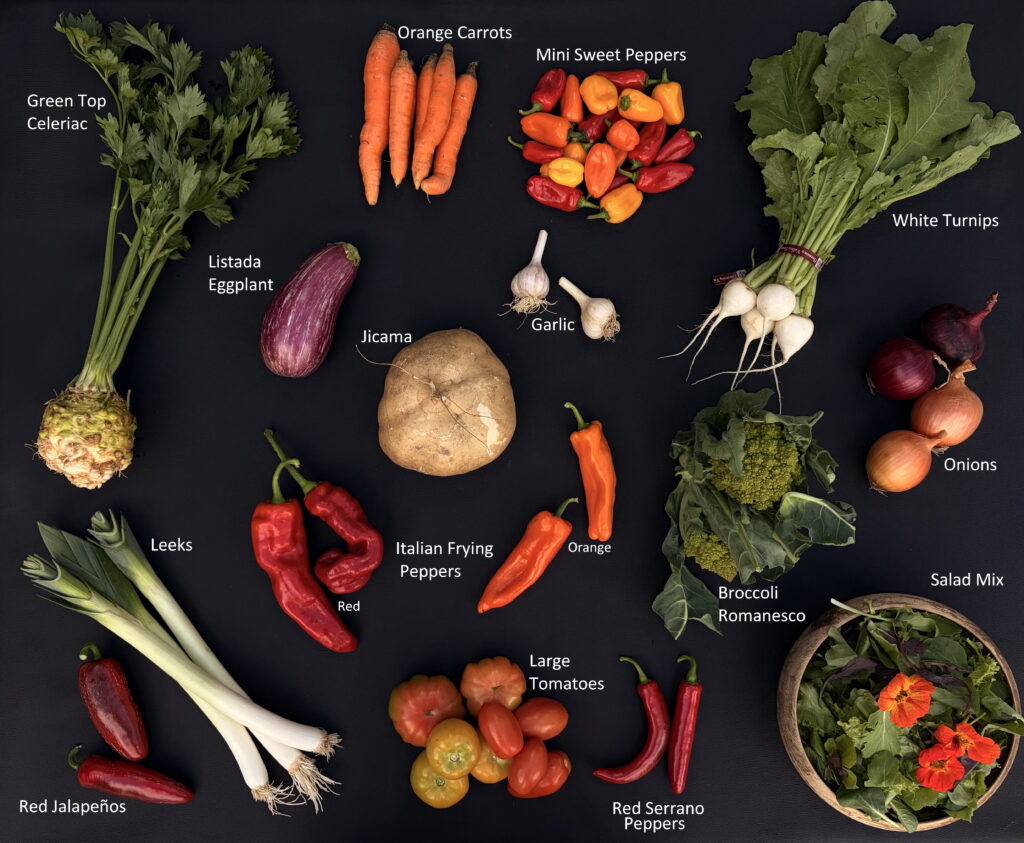
What’s In The Box with Recipe Suggestions
Orange Carrots: Ever considered making beverages out of carrots! Try one of the recipe suggestions below!
Cauliflower or Broccoli or Broccoli Romanesco: This week we continue to harvest from our fall Brassica crops.
Listada Eggplant: The eggplant field is bursting with gorgeous fruit and we’re happy to share more with you this week. If you are unfamiliar with eggplant, you can read more on our website.
Easy Baba Ghanoush (Eggplant Dip)
Moussaka (Greek eggplant & beef casserole)
Porcelain Garlic: Store garlic at room temperature until you are ready to use it. Adding a little garlic to your meals every day is a great way to support your immune system!
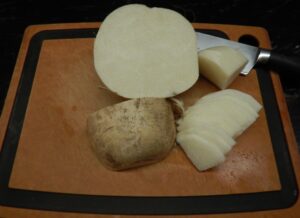
Jicama: This is the root vegetable in your box with light brown skin. You can read more about it in this week’s vegetable feature article. This is a tropical vegetable and is sensitive to chill injury if stored in the refrigerator. We recommend keeping it at room temperature. The skin may be peeled or cut away with a paring knife to uncover the solid, dense, white flesh inside. It is typically eaten raw but may also be cooked.
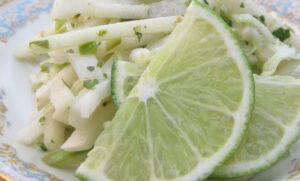
Jicama and Carrot Slaw with Honey-Lime Dressing
Leeks: Leeks are the more subtle cousin to onions. Part of the growing practice is to pile dirt up on the lower portion (aka shank) of the leek, which results in blanching that portion, so it remains white. As a result, dirt can get in between the layers. Take care to wash them well prior to using them to remove any remaining grit. When cooking, use lower heat to cook them so they are smooth and silky.
Red and Yellow Onions: If your household doesn’t use onions as frequently and you’re starting to accumulate a pile, consider making a large batch of caramelized onions. You can use the caramelized onions on sandwiches and burgers or eat them alongside grilled steak or pork chops. They are also delicious served with roasted vegetables, or add them to pizza, quesadillas or wraps!
How To Make Caramelized Onions
Red Jalapeños: Spice up this week’s jicama by pairing it with jalapenos in slaws & salsa. There are a few recipe suggestions below.
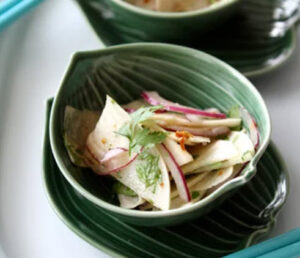
Jicama Slaw with Jalapeño Dressing
Mini Sweets Peppers: These multi-colored sweet peppers look like little bell peppers and are packed in a brown paper bag this week. If you’re packing a lunch to take to work or school, this is a great selection to include as they are easy to eat on their own or with a dip!
Hummus Stuffed Mini Sweet Peppers
Red Serrano Pepper: There are two serrano peppers in your box. It resembles a jalapeño pepper, although it is a bit more slender and longer than a jalapeño. As for the heat level, our crew members tell us they are a bit spicier than jalapeños. Use this week’s serrano and Jalapeno peppers to make a tasty tomatillo salsa!
Mango Shrimp Ceviche with Avocado
Orange and Red Italian Frying Peppers: These red and orange peppers have a long slender shape and are sweet peppers. Peppers are an easy vegetable to preserve for later use. Simply wash and cut into whatever form you prefer (slices, diced, etc.) and put them in a freezer bag. Pull them out in the winter and add them to soups, stews and chowders, use them as a pizza topping, or sauté them and add them to eggs.
Marinated Cabbage & Sweet Pepper Slaw
Sheet Pan Greek Roasted Potatoes with Peppers & Feta
Salad Mix: The baby lettuce and greens in this mix pair best with a light vinaigrette or a thin, creamy dressing. Toss just before serving so the greens do not get soggy.
Variety of Tomatoes: We are approaching the end of tomato season but still have enough to include a small bag in this week’s box. Enjoy one more BLT sandwich or whip up a batch of fresh salsa before we’re finished for the year!
Tomato Soup with Cheesy Crostini
17 Ways To Build a Better Tomato Sandwich
Baby White Turnips: We grow these salad turnips in the spring and again in the fall. They are also known as “hakurei” turnips. They are characterized by mild, tender turnips with edible green tops. Enjoy the greens and turnips raw in salads or lightly cook them by steaming, sautéing or roasting.
Turnip Salad with Yogurt, Herbs and Poppy Seeds
Green Top Celeriac: This is a round root vegetable with a celery-like green top. Celeriac is in the same family as celery. The difference is that celeriac is grown for its root and celery is grown for its stalks. The stalks on celeriac resemble celery and have a lot of delicious flavor in them, however they are more tough and fibrous than celery and are not usually eaten as you would eat a celery stalk. Use the tops to add depth to a pot of stock or soup.
Creamy Broccoli Romanesco & Cauliflower Soup with Bacon
Vegetable Feature: Jicama

Jicama is the odd-shaped vegetable with brown skin occupying one corner of this week’s CSA box. It is also known as yam bean, Mexican yam or Mexican turnip and is native to Mexico. The name of this vegetable is pronounced HICK-uh-mah or HEE-kuh-mah. It is a tropical plant that resembles a bean plant with bean-like vines and seed pods. The jicama grows underground and is a tuber that can produce multiple tubers off the one main stem. On the outside jicama is not the most attractive or flashy vegetable. Peel away the brown, leathery skin and you’ll find a solid white flesh inside that is mild in flavor, crunchy with a slight sweetness and slightly starchy.
You can eat jicama both raw and cooked. One of the most basic ways to eat jicama, and a common street food, is to slice it into sticks and give it a squeeze of lime juice and a light sprinkling of chili powder and salt. Jicama also pairs well with fruit including citrus (oranges, grapefruit, limes), pineapple, mango, and apples. It is common to see jicama slaws, salads and salsas that also include fruit. It also pairs well with avocado, hot, and sweet peppers, cilantro, tomatoes, seafood, onions, and garlic to name just a few complementary ingredients. In Asian cuisine you may find jicama used in stir-fry type preparations. When stir-fried, jicama should be added towards the end of cooking to retain the crisp texture. If you let it get just slightly soft, it has almost a potato-like flavor and texture.
We don’t grow jicama every year, but it has a permanent spot on our list of unique vegetables we grow from time to time. We grow jicama in the field on beds covered with green plastic mulch. We use a growing method similar to what we do for sweet potatoes, given they are both tropical plants. About a week before harvest, we cut all of the vines off the plants in an effort to “cure” them. The objective of this process is to set the skins, so they are less susceptible to injury when harvesting as well as to enhance their life. While jicama does have the ability to be stored for a while, we recommend you enjoy it within a week or so for optimal quality.
Jicama is very sensitive to chill injury, so it is best to store it on your kitchen counter until you are ready to use it. If you store it in the refrigerator, you’ll notice the quality will deteriorate quite quickly. Once you cut into it, store any cut jicama in the refrigerator and eat it within a few days. We hope you enjoy trying something different this week!