
Store Egyptian spinach in a warmer part of the refrigerator and use it within a few days of receiving it. If you’re not going to use it right away, freeze it for use later in the winter when your immune system needs a boost!
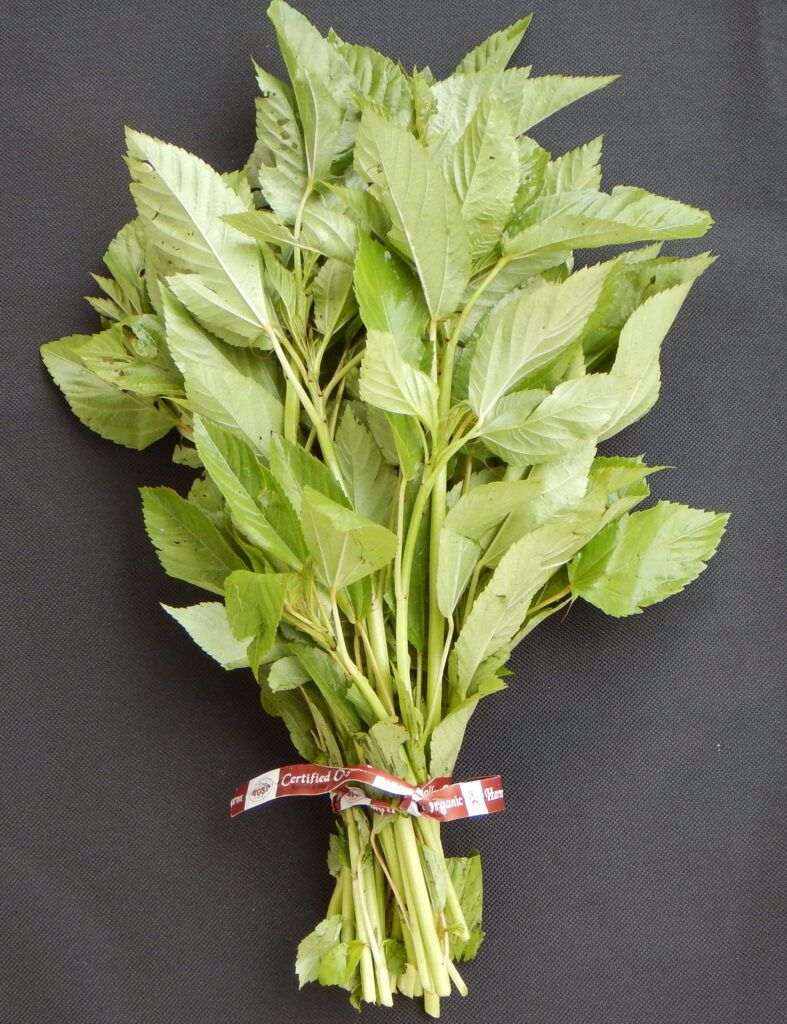
Egyptian spinach, also known as Molokai, jute mallow or Jew’s mallow, is a fast growing leafy green that is best suited to the heat of the summer. This vegetable is actually in the mallow family, and not related to spinach at all. The jute plant is an important plant in the natural fiber community as well as the food world. Egyptian spinach grows to be about 4 to 6 feet tall and is extremely bushy. Its long, lance shaped leaves can be harvested multiple times throughout the season.
The traditional way to serve Egyptian spinach is finely chopped into a soup with garlic and coriander that is served over rice with beef, lamb, or rabbit. When cooking Egyptian spinach in water or broth, it has a viscous consistency. This can be avoided by cooking it in butter or oil instead, and having very little water on the leaves, or by eating it raw. Dried leaves are often used as a thickener or brewed into tea. You can use Egyptian spinach in any recipe that you would use traditional spinach.
Cultural & Historical Background: As its common name suggests, Egyptian spinach originated in ancient Egypt, and continues to be an extremely popular vegetable in that country to this day. It is also an important part of Middle Eastern, West African, Indian and Southeast Asian cuisine.
We use cookies to improve your experience on our site. By using our site, you consent to cookies.
Manage your cookie preferences below:
Essential cookies enable basic functions and are necessary for the proper function of the website.
Google reCAPTCHA helps protect websites from spam and abuse by verifying user interactions through challenges.
Marketing cookies are used to follow visitors to websites. The intention is to show ads that are relevant and engaging to the individual user.
Google Maps is a web mapping service providing satellite imagery, real-time navigation, and location-based information.
Service URL: policies.google.com (opens in a new window)
You can find more information in our Privacy Policy and Privacy Policy.