
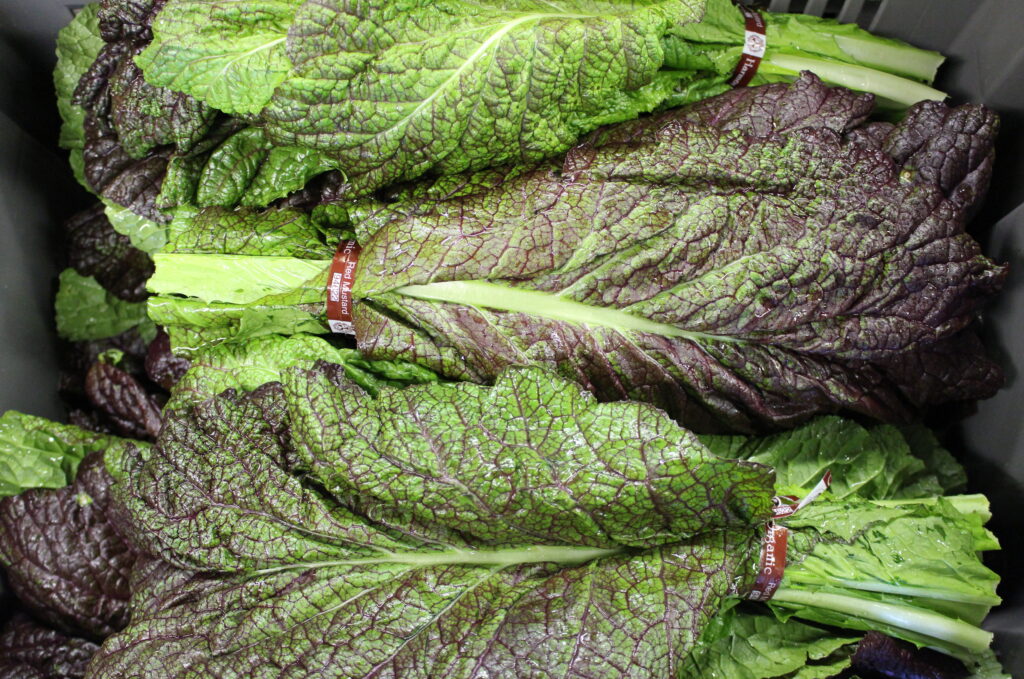
Mustard greens should be stored, unwashed, gently wrapped in a paper towel and placed loosely in a plastic bag. The bundle should be stored in the high-humidity bin of your refrigerator.
Mustard greens are in the brassica family, along with kale, cabbage and collard greens. The leaves are more delicate and tender than those of kale and collard greens. Mustard greens are less bitter than kale and collards, and are peppery like arugula. They come from the same plant that produces the seeds we use as seasoning. Since we are growing the plants for the greens, we don’t want to see any seeds, however, as the taste of the leaves is best before the plant goes to seed.
Before using your mustard greens, remove them from their stems, if you choose to do so. The stems are perfectly edible, although not as tender as the leaves, and many people keep them intact for added nutrients. You will also want to wash them well in a sink of cold water until all of the dirt has been removed. Mustard greens can be eaten raw, and when doing so, there is a distinct mustard flavor. That flavor mellow out with cooking, and this is the most popular way to eat them. You can simply sauté them with garlic and olive oil for a quick and easy side dish, or try adding them to a casserole or frittata. Mustard greens go well with ginger, sesame oil, soy sauce, white beans, garlic, onions, crushed red pepper, cream, shallots, bacon, eggs and white fish.
Health & Nutrition: Mustard greens are an excellent source of vitamins A, C and K, folate and manganese, as well as a good source of fiber.
Cultural & Historical Background: Mustard greens are frequently used in Chinese, Japanese and Indian cuisine, and are a staple in American Southern cooking.
We use cookies to improve your experience on our site. By using our site, you consent to cookies.
Manage your cookie preferences below:
Essential cookies enable basic functions and are necessary for the proper function of the website.
Google reCAPTCHA helps protect websites from spam and abuse by verifying user interactions through challenges.
Marketing cookies are used to follow visitors to websites. The intention is to show ads that are relevant and engaging to the individual user.
Google Maps is a web mapping service providing satellite imagery, real-time navigation, and location-based information.
Service URL: policies.google.com (opens in a new window)
You can find more information in our Privacy Policy and Privacy Policy.