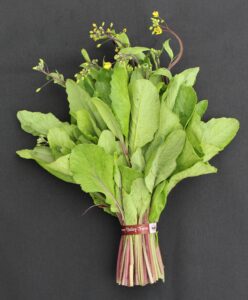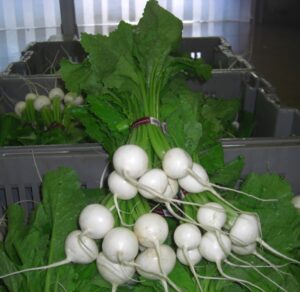

Remove greens and store each separately in a plastic bag in the refrigerator. If you notice dehydration (spongy and wrinkly), try soaking the radish in water to prolong freshness.
There are two classifications of radishes–”Table” or “Spring” radishes and “Storage” radishes. Table radishes are one of the first crops we plant in the spring, with harvest just 4 to 6 weeks later. Green top red and French breakfast radishes are the two varieties we grow. They are tender with a thin skin and are meant to be eaten within a week or so after they are harvested. We actually plant them all throughout the summer and into the early part of the fall.
None of these radishes require peeling, just give them a light washing. They are all good in their raw form, but can also be stir-fried, pickled, sautéed or even used in soups and braises. You can also roast them or use them in soups, stews, etc. Cooking will mellow the flavor significantly. When cooked, radishes lose their peppery flavor and become mild and slightly sweet in flavor. If you are one that shies away from radishes because you are still learning to like their peppery bite, consider cooking them. Don’t forget to eat the radish greens as well as they are packed full of nutrients! Radish greens may be added to stir-fries, simply sautéed alone or with other greens and dressed with salt and a splash of vinegar. They are often incorporated into soups and can also be eaten raw in salads. Quick pickled radishes make a nice condiment to enjoy on tacos, alongside grain dishes, lentils, beans or layered onto a sandwich.
Health & Nutrition: Radishes are a good source of vitamins A, C and B6 as well as magnesium, calcium and potassium. In traditional Chinese medicine, radishes are used to promote digestion, break down mucus, soothe headaches and heal laryngitis. They are beneficial in helping to cleanse and detoxify the body and it is thought that they help prevent viral infections, such as colds and the flu, when consumed regularly.
Cultural & Historical Background: Radishes are eaten extensively worldwide. Often they are pickled, cured, dried or fermented to preserve them. Historical reports date back to 2000 BC where radishes are thought to have been included in the daily ration, along with onions and garlic, for the people building the Egyptian pyramids.
We use cookies to improve your experience on our site. By using our site, you consent to cookies.
Manage your cookie preferences below:
Essential cookies enable basic functions and are necessary for the proper function of the website.
Google reCAPTCHA helps protect websites from spam and abuse by verifying user interactions through challenges.
Marketing cookies are used to follow visitors to websites. The intention is to show ads that are relevant and engaging to the individual user.
Google Maps is a web mapping service providing satellite imagery, real-time navigation, and location-based information.
Service URL: policies.google.com (opens in a new window)
You can find more information in our Privacy Policy and Privacy Policy.